Macro Calculator: How to Split Calories Into Macros
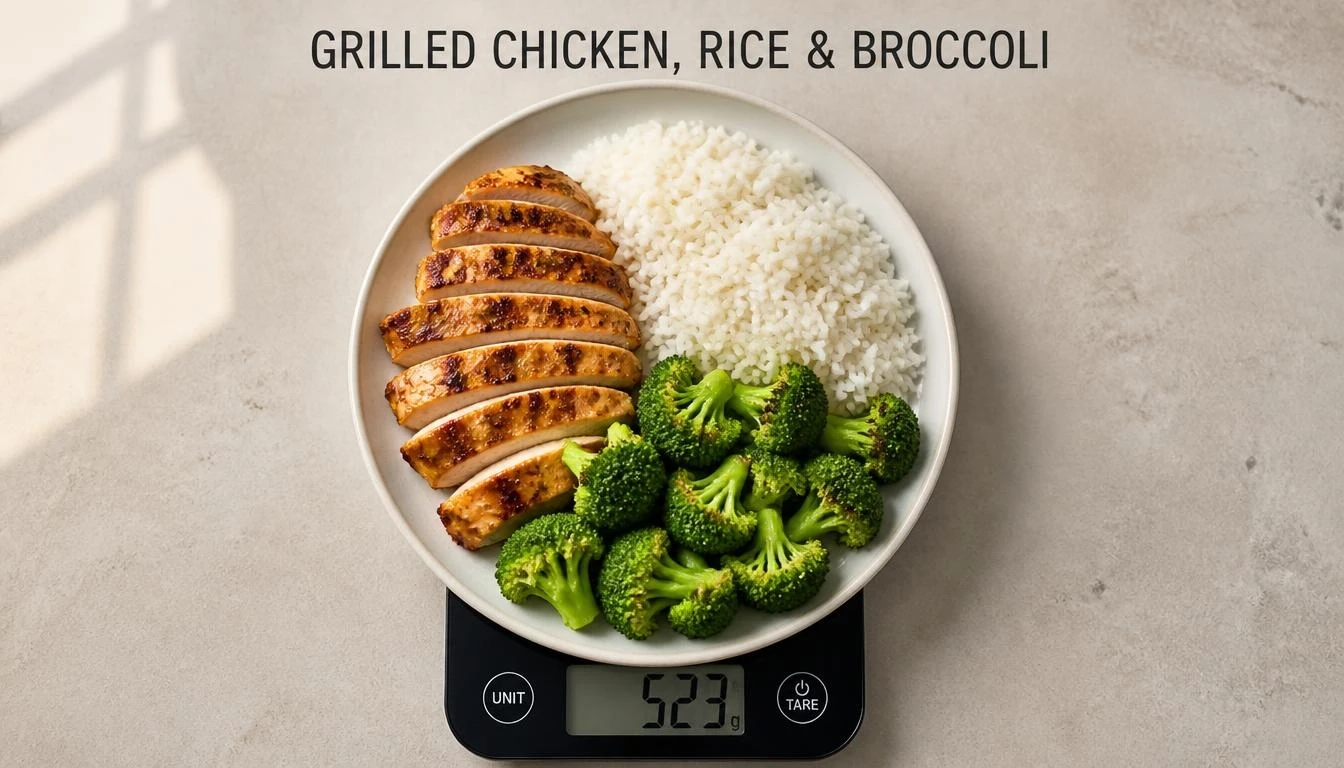
A macro calculator takes the calories you plan to eat each day and turns them into grams of protein, carbs and fat. You give it calories, body weight and a goal. Protein is settled first, fat second, and carbs absorb whatever is left, so you end up with amounts you can weigh on a kitchen scale.
The arithmetic is quick. The decisions around it take longer. Using our macro calculator, this guide shows how to calculate macros from calories, what macros for cutting and macros for lean bulk look like for an 80 kg lifter, and what’s going on when a tool complains that your calories are too low.
- Protein comes from body weight and fat from a share of calories. Carbs get the remainder. Protein and carbs are 4 calories a gram, fat is 9.
- For an 80 kg lifter on 2,000 calories, a cut works out to 160 g protein, about 56 g fat and 215 g carbs.
- The tool sets protein at 2.0 g per kg to lose fat and 1.6 g per kg to maintain or build, with fat at 20, 25 or 30%.
- Every five points of fat share trades roughly 31 g of carbs at 2,500 calories.
- Your calories are your call. Research backs losing 0.5 to 1% of body weight a week on a cut and eating 10 to 20% above maintenance on a lean bulk.
What is a macro split, and what does a macro calculator do?
Protein, carbohydrate and fat are the macronutrients, the three sources of the calories you eat. A macro split describes how a day’s intake is shared among them. A macro calculator does the sharing and reports it in grams, the unit you shop and cook in.
Our free macro calculator asks for daily calories, body weight and a goal, and lets you choose what share of calories comes from fat. Results come back as numbers and as a single bar: protein in red, carbs in white, fat in grey.
Energy per gram is fixed. Protein and carbs yield 4 calories and fat yields 9. These Atwater factors are the standard way to work out the energy in food.
Our view: grams beat percentages day to day. A percentage gives you the shape of the day, and grams tell you what goes on the plate.
How to calculate macros from calories: protein, fat, then carbs
Order is everything here. Protein goes first, since it follows your body size and not your appetite. Fat comes next as a share of calories. Carbs fill the gap.
Try an 80 kg lifter cutting on 2,000 calories with fat at 25%. Protein at 2.0 g per kg comes to 160 g, or 640 calories. A quarter of 2,000 is 500 calories of fat, about 56 g. The remaining 860 calories go to carbs, which is 215 g. Add the three back together and you’re at 2,000 again.
| Macro | Grams | Calories | Share |
|---|---|---|---|
| Protein | 160 g | 640 | 32% |
| Fat | 56 g | 500 | 25% |
| Carbs | 215 g | 860 | 43% |
Enter your calories, goal and weight to get daily grams of protein, carbs and fat, drawn as a share of your calories. Free, no sign-up.
Open the calculator- Pick metric or imperial.
- Enter your daily calories in kcal.
- Add your body weight.
- Choose a goal. Lose fat sets protein to 2.0 g per kg, while maintain and build muscle both use 1.6.
- Set fat to 20, 25 or 30%, then press calculate and read off the grams.
The grams in the results table are rounded. Fat is a fair example: 56 g is 504 calories, not 500. Weigh a day out to the gram and you can land a few calories off target, which is nothing to worry about.
What do macros for cutting look like?
A cut puts protein under pressure. Helms, Aragon and Fitschen reviewed contest preparation for natural bodybuilders and landed on 2.3 to 3.1 g of protein per kg of lean body mass, 15 to 30% of calories from fat, and carbs for everything else. Leaner lifters need more protein. The same review suggests losing 0.5 to 1% of body weight a week to protect muscle.
The tool works from total weight, not lean mass, so it fixes protein at 2.0 g per kg. Someone near 15% body fat would need about 1.95 g per kg of total weight to reach 2.3 g per kg of lean mass. That puts 2.0 near the low end of the research. Go higher if you’re very lean.
For 80 kg, a loss of 0.5 to 1% is 0.4 to 0.8 kg a week. The macro calculator can’t aim for that pace, because it never touches your calories. What it can show is how each calorie level squeezes carbs.
Protein and fat share stay put, so carbs take the hit. Macros for cutting at 2,000 calories are 160 g protein, 56 g fat and 215 g carbs, and every 200 calories you trim removes 37.5 g of carbs.
In our view, keep protein steady and let carbs flex. Lowering protein to make room is the wrong trade.
Which macros for lean bulk should you start with?
A lean bulk is a modest surplus: enough to grow, not enough to pile on fat. Iraki and colleagues reviewed off-season eating for natural bodybuilders and put the surplus at roughly 10 to 20% above maintenance. Novice and intermediate lifters can aim to gain 0.25 to 0.5% of body weight a week. Advanced lifters should be more cautious.
Their ranges are 1.6 to 2.2 g of protein per kg, 0.5 to 1.5 g of fat per kg, and carbs from the remainder, at least 3 to 5 g per kg. The build setting uses 1.6 g of protein per kg, the bottom of that protein range.
The surplus is yours to set, because the macro calculator only splits the calories you enter. With maintenance at 2,500, the 10 to 20% window runs from 2,750 to 3,000 calories.
| Goal | Calories | Protein | Fat | Carbs |
|---|---|---|---|---|
| Cut | 2,000 | 160 g | 56 g | 215 g |
| Maintain | 2,500 | 128 g | 69 g | 341 g |
| Lean bulk | 2,800 | 128 g | 78 g | 397 g |
Take the 2,800-calorie row: 128 g protein, about 78 g fat and 397 g carbs. That’s roughly 1 g of fat and 5 g of carbs per kg, inside both ranges.
Our view: for macros for lean bulk, begin at the low end of the surplus. Muscle gain has a ceiling, and a bigger surplus past it mostly adds fat. If you gain faster than 0.5% of body weight a week, trim calories and run the numbers again.
How far does fat share move your macros for fat loss?
Fat share is the dial you get to turn. Here’s the same 80 kg lifter at 2,500 calories, with protein at 1.6 g per kg, or 128 g.
| Fat share | Fat | Carbs | Carbs as share of calories |
|---|---|---|---|
| 20% | 56 g | 372 g | 59.5% |
| 25% | 69 g | 341 g | 54.5% |
| 30% | 83 g | 310 g | 49.5% |
Each five-point step swaps about 31 g of carbs for about 14 g of fat. Neither end is wrong. For macros for fat loss, take the end you can live with, and adjust the fat share setting if training or hunger pushes back.
The tool stops at 20, 25 and 30% because that’s where Helms’ 15 to 30% range overlaps the 20 to 35% general-health range from the Institute of Medicine.
Our view: begin at 25%. Drop to 20% if training feels flat, since that frees up carbs. Move to 30% if you’re hungry between meals.
What does the research say about your macro split?
Protein has the best evidence. Morton and colleagues pooled 49 studies with 1,863 participants in a 2018 meta-analysis. In trials of lifters taking protein supplements, intakes above about 1.6 g per kg a day gave no extra fat-free mass. That’s why maintain and build use 1.6. The paper measures muscle gain, so it says less about dieting. Our protein calculator guide digs into that side.
For adults, the Institute of Medicine sets general-health ranges: 20 to 35% of calories from fat, 45 to 65% from carbs and 10 to 35% from protein. They’re built for whole populations, not for someone cutting. The 2,000-calorie example has protein at 32%, fat at 25% and carbs at 43%, a touch under the carb range. For a lifter who’s dieting, that’s acceptable.
In our view, once calories and protein are settled, the fat and carb split is mostly taste. Don’t lose sleep over it.
Why does a macro calculator say your calories are too low?
Occasionally protein and fat use up every calorie you have, which would leave carbs below zero. The tool flags that instead of printing a negative number.
| Fat share | Fat | Carbs left |
|---|---|---|
| 20% | 27 g | 20 g |
| 25% | 33 g | 5 g |
| 30% | 40 g | None, 40 calories short |
That’s an extreme case, shown to locate the wall and not as a target. Raise calories or lower fat share and the wall moves. If your plan only works at numbers this low, see a registered dietitian first.
Which macro calculator mistakes cost you the most?
- Guessing your calories. A neat split of the wrong number is still the wrong plan, so find maintenance first with the reverse TDEE calculator.
- Leaving the unit on the wrong setting.
- Reading rounded grams as exact.
- Trimming protein to buy more carbs.
- Moving every dial at once. Change one, then watch weight and training for a few weeks.
- Expecting settings it doesn’t have: no fiber, sugar or saturated fat targets, and no fixed carb targets for endurance work.
- Overlooking body fat. Protein comes from total weight, so it runs high for people carrying a lot of fat and low for very lean lifters. The protein calculator gives a range if that’s you.
In our view the first mistake does the most damage, since everything else sits on top of it.
Frequently asked questions
How do you calculate macros from calories?
Protein and carbs count 4 calories a gram and fat counts 9. Set protein from body weight, set fat as a share of calories, then divide what's left by four to get carbs. A macro calculator does it in a click.
What are good macros for cutting?
There's no single answer. We start at 2.0 g of protein per kg with 25% of calories from fat, which gives an 80 kg lifter on 2,000 calories 160 g, 56 g and 215 g.
What macros should you eat on a lean bulk?
Aim for calories 10 to 20% over maintenance, 1.6 g of protein per kg, a moderate fat share and carbs for the rest. An 80 kg lifter on 2,800 calories gets 128 g, 78 g and 397 g. If weight rises faster than 0.5% a week, trim calories.
How much protein does the macro calculator use?
The lose-fat setting uses 2.0 g per kg. Maintain and build use 1.6 g, the point where one 2018 meta-analysis of lifters saw no extra muscle gain.
Does a macro calculator choose my calories?
It doesn't. You type your calories and it divides them. Work out maintenance first, then choose a deficit or surplus.
Is the macro calculator free?
Yes, with no account needed. It runs in your browser, so nothing you type is stored or sent anywhere. Use it as often as you like.
What I’d actually do
Say a lifter weighs 75 kg and has worked out maintenance at 2,500 calories. They want to cut.
Take 500 off. That’s 2,000 a day. By the usual 3,500-calories-a-pound rule it’s roughly 0.45 kg a week, or 0.6% of body weight. Inside the 0.5 to 1% window.
Protein first: 75 × 2.0 = 150 g. That’s 600 calories.
Fat at 25% is 500 calories, so 56 g.
Carbs get the other 900. That’s 225 g.
I’d start there and leave it alone for a few weeks. If you’re flat in the gym, drop fat to 20%, which gives 44 g of fat and 250 g of carbs. If you’re hungry between meals, go to 30%, which is 67 g and 200 g. Protein stays at 150 g either way.
That’s the whole routine: set calories, take protein from weight, take fat from a share, give carbs the rest. Run your own numbers through the macro calculator and check that the grams add back up to your calories. More tools live in our nutrition tools.
If you’d rather have a whole month laid out for you, you can grab the $27 30-Day Reset program from our sister site Bodylix.