Protein Calculator: How Much Protein You Need Per Day for Your Goal
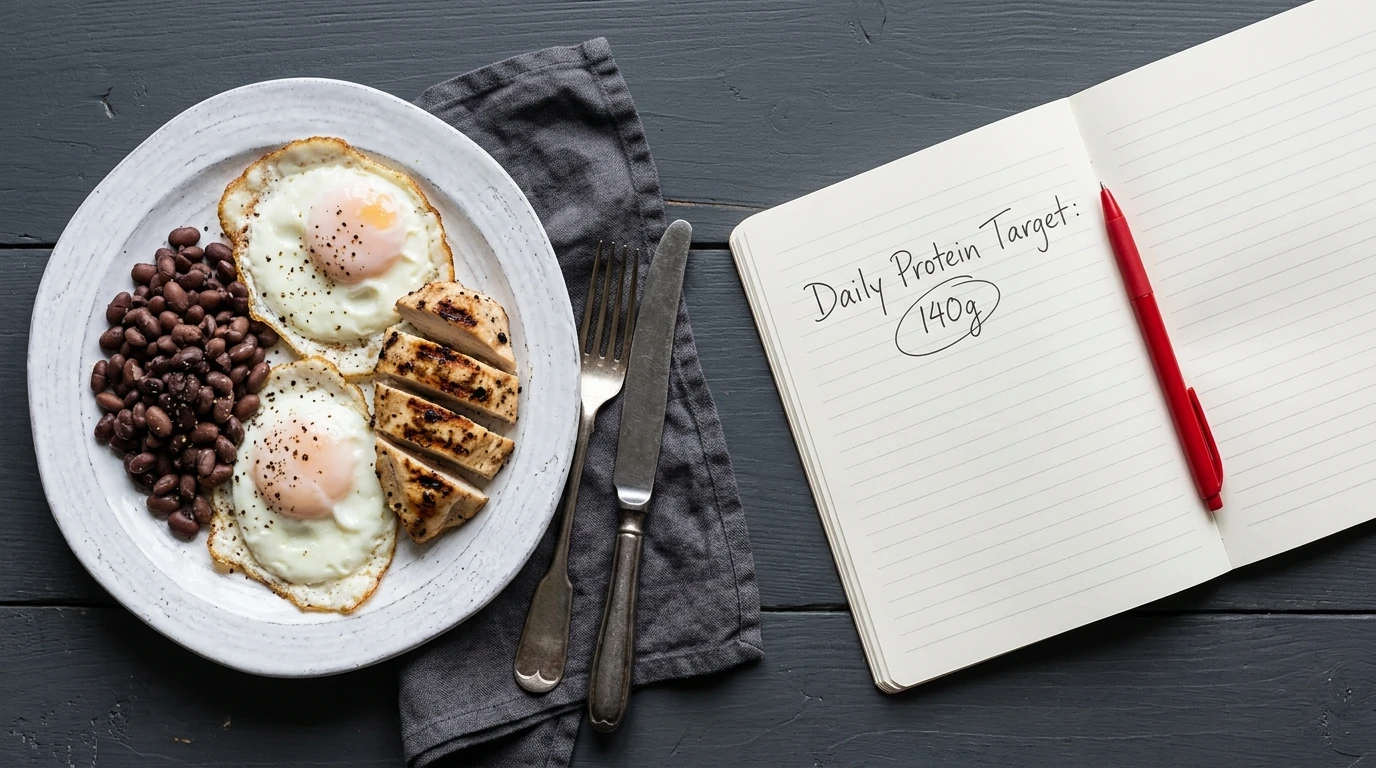
A protein calculator turns your body weight and your goal into a daily range in grams. Multiply grams per kilogram by your weight and you’re done. What’s worth understanding is where the grams-per-kilogram figure comes from, because it shifts a lot with what you’re trying to do.
The sum is the easy part. The range is where all the disagreement lives. This guide walks through the range for each case: how much protein per day, how much to build muscle, what changes while you’re cutting, and what it means per pound, per meal and after 65. To run your own numbers, our protein calculator does the sum and shows the evidence next to your range.
- A protein calculator multiplies grams per kg by your body weight. Choosing the range for your goal is the real decision.
- To build muscle, aim for 1.6 to 2.2 g/kg. Gains in the 2018 Morton meta-analysis levelled off around 1.62 g/kg.
- While cutting, 1.6 to 2.4 g/kg is a sensible range. In one four-week trial of young men, 2.4 beat 1.2 for both lean mass and fat loss.
- Per meal, about 0.25 g/kg or 20 to 40 g is the usual guide. The timing evidence is mixed, so get the daily total right first.
- The RDA of 0.8 g/kg is a floor, not a target. For an 80 kg lifter building muscle, the range is 128 to 176 g a day.
What does a protein calculator actually do?
The same sum, every time. Pick a range in grams of protein per kilogram of body weight, multiply by your weight, and read off a daily range in grams.
For an 80 kg lifter, 1.6 to 2.2 g/kg becomes 128 to 176 g a day.
Where calculators differ is the range, and plenty of them hide the choice. They show one number, say 150 g, as if it came out of a lab. It didn’t. It’s a point inside a range that researchers still argue about.
We think the biggest upgrade you can make to a protein calculator is to show the range and say which ends came from a paper and which are a judgment call. Ours does that, and the table below lists every one.
| Goal | g per kg | 80 kg lifter | Where it comes from |
|---|---|---|---|
| Build muscle | 1.6 to 2.2 | 128 to 176 g | Morton 2018 breakpoint, up to the top of its confidence interval |
| Lose fat, keep muscle | 1.6 to 2.4 | 128 to 192 g | Morton breakpoint to the high arm of Longland 2016. The span between is our judgment |
| Stay active, keep muscle | 1.4 to 2.0 | 112 to 160 g | ISSN position stand, 2017 |
| General health | 0.8 to 1.2 | 64 to 96 g | RDA floor, plus our margin on top |
| Over 65, general health | 1.0 to 1.2 | 80 to 96 g | PROT-AGE group, 2013 |
How much protein per day do you need?
It depends on what you’re doing with it. The RDA for healthy adults is 0.8 g/kg, which is 64 g for an 80 kg person. That’s the amount that stops most people becoming deficient. The ISSN position stand puts most exercising people higher, at 1.4 to 2.0 g/kg, or 112 to 160 g for the same 80 kg person.
Here are all five ranges plotted against two reference lines: the RDA and the muscle-gain breakpoint.
“Per day” is an average, not a nightly pass or fail. We’d judge it across a week.
Look at how much the bars overlap. Someone eating 1.8 g/kg sits inside the muscle-building, fat-loss and active ranges at once. That’s why arguing over 1.6 versus 1.8 is mostly a waste of breath.
How much protein to build muscle
The figure everyone quotes comes from a 2018 meta-analysis by Morton and colleagues. They pooled 49 trials and 1,863 people who trained with weights for at least six weeks, and asked how much total protein it took before more protein stopped adding muscle. The answer was 1.62 g/kg a day. The margin of error around it was wide and reached about 2.2 g/kg, which is where the usual 1.6 to 2.2 range comes from.
Two details matter. Protein helped more in people who were already trained, and less as people got older. And the trials tested protein supplements, so 1.62 is an estimate of where gains level off, not a wall.
In practice, treat 1.6 g/kg as a sensible floor and 2.2 as the top of the useful range. Past that, the average trial result says you’re mostly buying protein you don’t need. Protein per kg is the unit nearly every study uses, which is why it’s the unit our protein calculator works in first.
Protein intake for fat loss
Dieting changes things. In a 2016 trial, 40 young men ate about 40% below their energy needs for four weeks while training six days a week. The group eating 2.4 g/kg gained about 1.2 kg of lean mass and lost 4.8 kg of fat. The group eating 1.2 g/kg gained about 0.1 kg of lean mass and lost 3.5 kg.
Weigh that against the fine print. Four weeks, young men, a punishing training load, and one author disclosed funding from dairy industry groups. It’s one trial, not the last word.
For lean, trained athletes in a hard cut, a 2014 review of six studies went higher: 2.3 to 3.1 g per kg of lean mass, scaled up with how aggressive the diet is and how lean you already are. That’s a specialist range, and here’s how it compares for a typical lifter.
| Method | Range | Grams a day | Best for |
|---|---|---|---|
| Per kg of body weight | 1.6 to 2.4 g/kg | 128 to 192 g | Most people cutting |
| Per kg of lean mass | 2.3 to 3.1 g/kg | 147 to 198 g | Lean, trained athletes in a hard cut |
The two routes overlap for this lifter. The lean-mass route climbs higher the leaner you already are. If your deficit is modest, we’d start in the lower half of the range and see how training feels before pushing up.
Don’t know your body fat? Our body fat percentage calculator estimates it with a tape measure, and the reverse TDEE calculator sets the calories to go with it.
Protein per pound of bodyweight
If you count in pounds, the conversion is a division by 2.2. Studies report protein per kg, so every number in this guide started life in that unit. A range of 1.6 to 2.2 g/kg is about 0.7 to 1.0 g per pound.
| g per kg | g per lb | 180 lb lifter |
|---|---|---|
| 0.8 | 0.36 | 65 g |
| 1.0 | 0.45 | 82 g |
| 1.4 | 0.64 | 114 g |
| 1.6 | 0.73 | 131 g |
| 2.0 | 0.91 | 163 g |
| 2.2 | 1.00 | 180 g |
| 2.4 | 1.09 | 196 g |
That makes the old one-gram-per-pound rule 2.2 g/kg. It sits at the very top of Morton’s interval, so it’s generous, not wrong. Anywhere from about 0.7 g per pound up is inside the range the research supports for building muscle.
How much protein per meal
The ISSN position stand suggests about 0.25 g/kg per serving, or an absolute 20 to 40 g, spread every three to four hours. For an 80 kg person that’s 20 g.
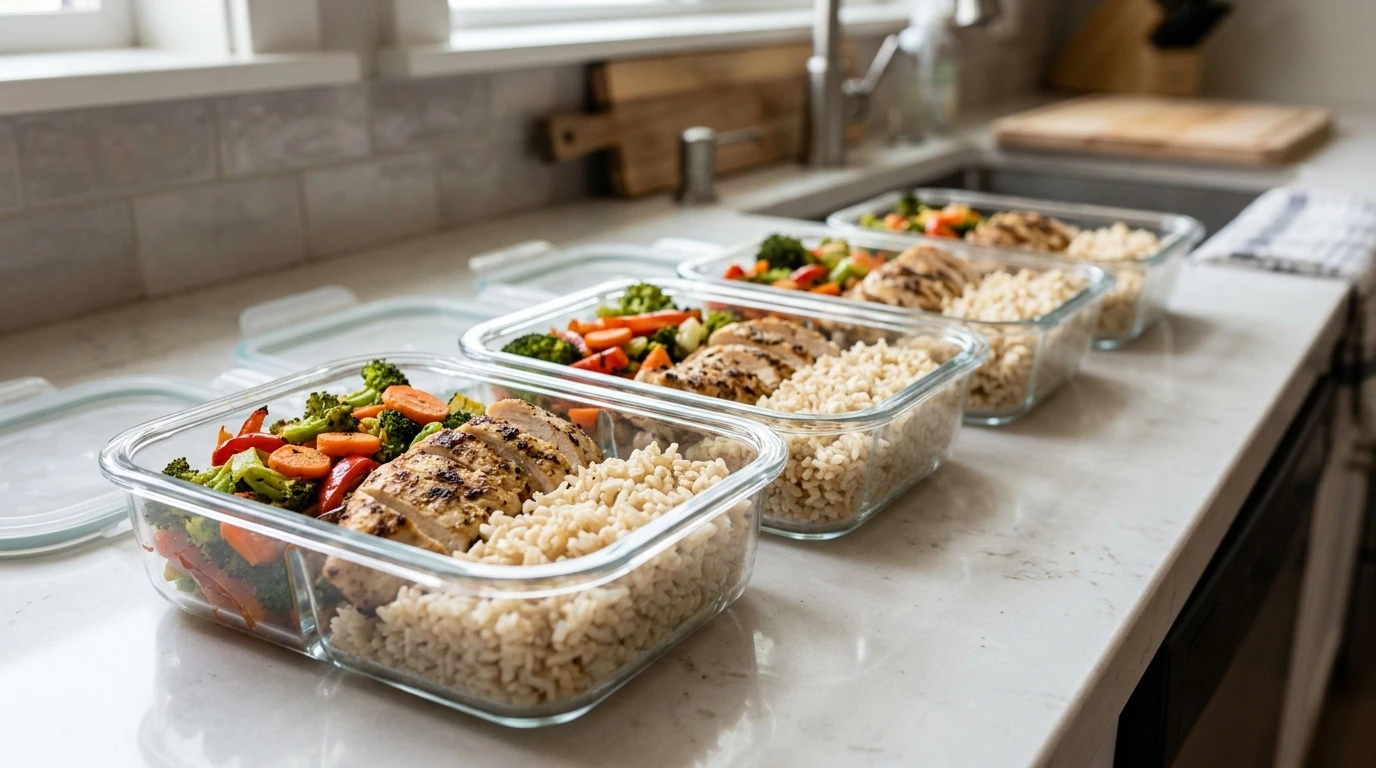
Say your aim is 150 g. Over four meals that’s 38 g each, inside the guide. Over three meals it’s 50 g each, so you’d add a snack or a fourth meal. The protein calculator runs this split for 3 to 6 meals and flags anything above the 40 g guide.
The timing evidence is mixed. A 2014 review of natural bodybuilding preparation found that changes in timing and frequency had little effect on fat loss or lean mass retention. So don’t stress about exactly 25 g at 3 p.m. Get the daily total right first.
How much protein do older adults need?
The PROT-AGE study group recommends at least 1.0 to 1.2 g/kg a day for healthy adults over 65, and 1.2 to 1.5 g/kg for people with acute or chronic illness. For a 75 kg person, the lower tier is 75 to 90 g.
Two cautions. Most muscle-building research, Morton’s included, is in younger adults, and Morton found protein helped less as age rose. And anyone with kidney disease or another medical condition should settle the number with their doctor, not a calculator.
How to use a protein calculator well
Enter your weight and goal for a daily protein range, a per-meal split, and the evidence behind it. Free, no sign-up.
Open the calculator- Pick the goal that matches what you’re doing now, not what you did last year.
- Enter your weight in kg or lb. If you’re cutting and know your body fat, add that too.
- Read the range, then choose a spot in it. The “aim for” figure is the midpoint.
- Set your meals per day and check the per-meal number against the 20 to 40 g guide.
- Eat to it for two or three weeks, then adjust by how your training, hunger and recovery feel.
If you add your daily calories, the tool also shows protein as a share of them. It’s a free protein calculator with no sign-up, and it runs in your browser.
Mistakes that skew your protein target
- Treating the RDA as a goal. It’s the floor for avoiding deficiency.
- Reading one number from a calculator as if someone measured it. It’s a range, always.
- Using total body weight when you carry a lot of extra fat. A per-kilo figure can run high there, which is why the protein calculator has a lean-mass view.
- Copying a lean athlete’s 3 g/kg because it sounds serious.
- Changing the target every week. Give a range two or three weeks.
Frequently asked questions
How much protein do I need per day?
It depends on what you're doing. The RDA is 0.8 g per kg, which only keeps you out of deficiency. If you train, 1.4 to 2.0 g per kg is where most people land, so an 80 kg lifter is looking at about 112 to 160 g.
How much protein do I need to build muscle?
Start at 1.6 g per kg and don't bother going much past 2.2. That's the range that falls out of the big 2018 meta-analysis, where extra protein stopped helping on average around 1.62 g per kg. For 80 kg, think 128 to 176 g.
How much protein should I eat for fat loss?
A bit more than you'd eat otherwise, usually 1.6 to 2.4 g per kg. In one four-week trial of young men on a hard diet, the 2.4 group gained more lean mass and lost more fat than the 1.2 group. Very lean athletes cutting hard sometimes go higher.
How much protein per meal is best?
Roughly 20 to 40 g, or 0.25 g per kg, every three to four hours. Honestly, the timing research is mixed, so nail your daily total first and worry about the rest later.
How many grams of protein per pound of bodyweight?
Divide the per-kg figure by 2.2. So 1.6 to 2.2 g per kg works out to about 0.7 to 1.0 g per pound, which makes the old one-gram-per-pound rule the top of the range, not the middle.
Is there a free protein calculator with no sign-up?
Yes, ours. No account, no email, and it all runs in your browser, so nothing you type gets stored.
What I’d actually do
Take a 75 kg lifter who’s building muscle. The range is 120 to 165 g a day, the midpoint is about 145 g, and over four meals that’s roughly 36 g each. Not a scary number. You just won’t know whether you’re hitting it until you write it down.
So do that. Enter your own weight in the protein calculator, pick the goal that fits this month, and log one ordinary week of eating before you change anything. Your real intake and your guess will probably disagree. Fine. That gap is the useful part.
Give the new target two or three weeks, not two or three days. If you’re cutting, add your body fat and read the lean-mass line before pushing higher, and our reverse TDEE guide covers the calorie side.
And if you’d rather have a whole month laid out for you, you can grab the $27 30-Day Reset program from our sister site Bodylix. Otherwise, the rest of our nutrition tools are a click away.