Plate Loader Calculator: How to Load Any Barbell Weight
A plate loader calculator turns the weight you want on the bar into the plates that go on each side. Enter the total, pick your bar, and it takes off the bar, halves the rest and builds a stack from the plates you own. No mental arithmetic halfway through a session.
The first step is simple enough for a phone calculator. The harder parts are choosing real plates, switching between kilos and pounds, and knowing what your bar weighs. This guide covers all of it, using numbers from our plate loader calculator. By the end you’ll know the plates per side for 100 kg, why 225 lb isn’t 100 kg, and how far a plate can stray from its label.
- Plates per side = (target − bar − collars) ÷ 2. For 100 kg on a 20 kg bar, that’s 40 kg a side.
- Lots of mixes make 40 kg. The tool picks the fewest plates, heaviest first, so you get 25 + 15 and not 20 + 20.
- 225 lb is 102.1 kg, and a 45 lb bar is 20.41 kg. Kilo and pound programs don’t swap cleanly.
- IWF bars weigh 20 kg (men) and 15 kg (women), and collars add 2.5 kg each, so a men’s bar with collars is 25 kg.
- Training discs can legally be 0.8% off, which is 160 g on a 20 kg plate.
What does a plate loader calculator do?
It converts a total barbell weight into a plate list. That sounds trivial until you’re tired, in a hurry, or in a gym that mixes pounds and kilos. A barbell plate calculator takes the sum off your plate, if you’ll forgive the pun, and shows both sides so nothing gets loaded lopsided.
The sum itself is short. Take the weight you want on the bar, subtract the bar and any collars, and halve the rest.
That gives a weight, not a stack. Plenty of plate mixes land on the same number, and a plain calculator won’t pick one. Ours takes the fewest plates and, when two mixes tie, the heavier-first one. Our view: fewest plates is the right default. Every extra disc is one more thing to slide on and count twice.
A plate loader calculator needs three inputs to be any use: the unit, the bar and the plates your gym really has. Skip one and it’s guessing. It should also say so when your target can’t be built exactly, which we’ll get to below.
What are the plates per side for 100 kg?
On a 20 kg bar with no collars, 100 kg leaves 80 kg of plates. Split across two sleeves, that’s 40 kg a side. So the plates per side for 100 kg are a 25 and a 15.
A pair of 20s reaches the same weight with the same plate count. The tie rule puts the heavier plate first, which is why the 25 wins. Add competition collars and the picture shifts: 100 − 20 − 5 leaves 75 kg, so 37.5 a side. That’s 25 + 10 + 2.5.
Here are the other loads people ask about most, worked the same way.
| Target | Plates each side | Load each side with |
|---|---|---|
| 60 kg | 20 kg | 20 |
| 80 kg | 30 kg | 25 + 5 |
| 100 kg | 40 kg | 25 + 15 |
| 120 kg | 50 kg | 2 × 25 |
| 140 kg | 60 kg | 2 × 25 + 10 |
| 180 kg | 80 kg | 3 × 25 + 5 |
| 200 kg | 90 kg | 3 × 25 + 15 |
If your target isn’t in the table, the free plate loader calculator will do it in a second. Our view: memorise the 100 kg answer. It’s a quick sanity check on any bar you walk up to.
A good plate loader calculator also tells you when a target is out of reach, instead of quietly handing back a different weight. Ask for a load your smallest plate can’t make and it names the closest builds on either side.
How to load a barbell with our plate loader calculator
How to load a barbell comes down to doing the sum before you touch a plate, then building both sides the same way. The tool handles the sum.
Type the weight you want on the bar and see exactly which plates go on each side, with the bar drawn out. Free, no sign-up.
Open the calculator- Pick kilograms or pounds first. The bar and plate options change with the unit.
- Enter the total you want on the bar, bar included.
- Choose your bar, or type a custom weight, and say whether collars count.
- Tick the plates your gym has and how many pairs of each.
- Read the stack, then load the heaviest plates closest to the middle on both sides.
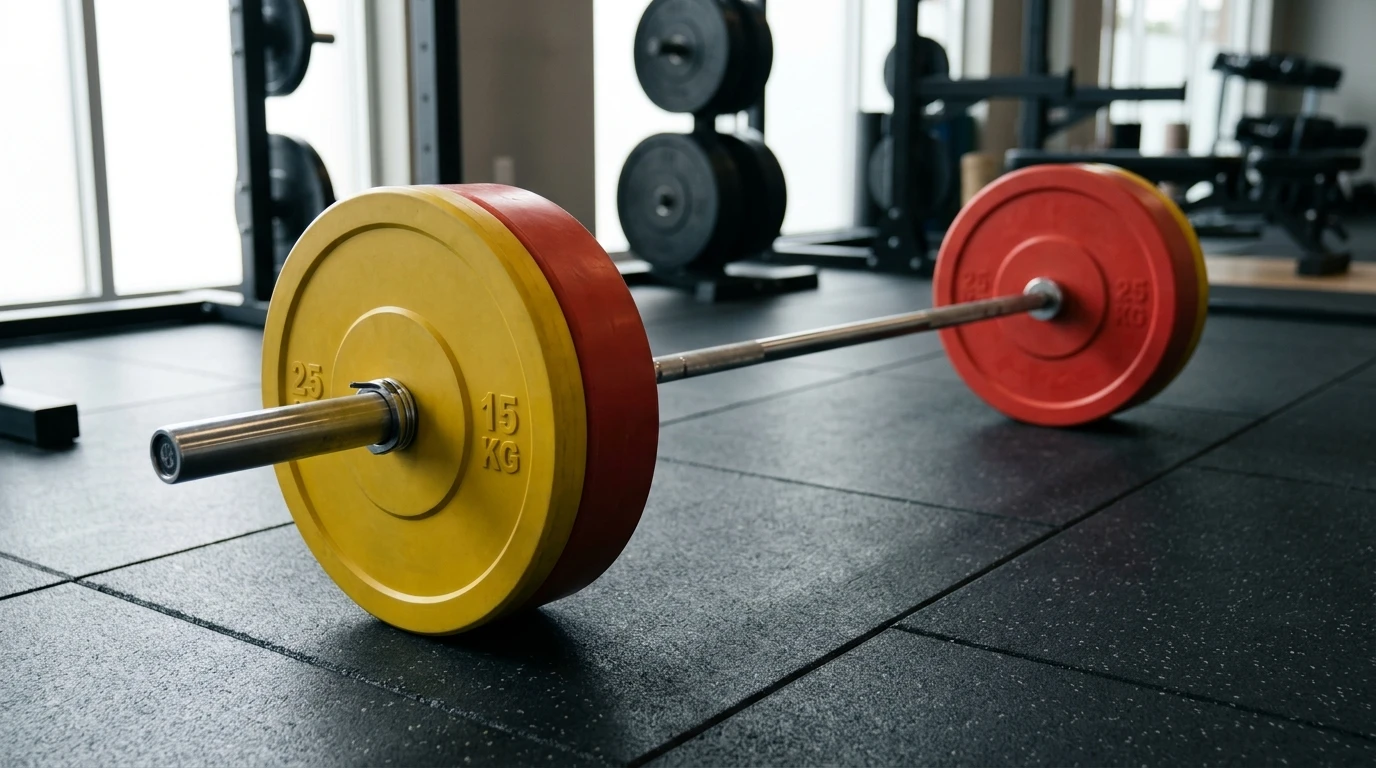
Untick a plate size you don’t own and the answer changes. So does the number of pairs on the rack, which most barbell plate calculator pages skip. The bar on screen is drawn to look right, not to scale.
What does a barbell weight chart say about the bar?
Know the bar before you trust the load. Under International Weightlifting Federation rules the men’s bar weighs 20 kg and the women’s weighs 15 kg, and each barbell takes two collars at 2.5 kg apiece. A men’s bar with collars on is therefore 25 kg before a single plate goes on. This barbell weight chart covers the usual cases.
| Setup | Weight |
|---|---|
| Men’s IWF bar | 20 kg |
| Women’s IWF bar | 15 kg |
| Pair of competition collars | 5 kg (2 × 2.5 kg) |
| Men’s bar with collars | 25 kg |
| Women’s bar with collars | 20 kg |
| 45 lb bar | 20.41 kg |
Light spring clips are a different story. Most people leave them out of the sum, and the tool does too unless you give it a collar weight. If your bar is neither of the IWF ones, set a custom bar weight in the plate loader calculator and type its weight in. We’d check the label on the sleeve before assuming 20.
Why isn’t 225 lb the same as 100 kg? A kg to lb plate conversion
Pound gyms use different plates, and the numbers don’t line up with kilos. A 45 lb bar is 20.41 kg, a touch heavier than a 20 kg bar. One pound is defined as exactly 0.45359237 kg, so 225 lb comes to 102.1 kg. Going the other way, 100 kg is 220.5 lb.
| Target | In kg | Plates each side | Load each side with |
|---|---|---|---|
| 95 lb | 43.1 kg | 25 lb | 25 |
| 135 lb | 61.2 kg | 45 lb | 45 |
| 185 lb | 83.9 kg | 70 lb | 45 + 25 |
| 225 lb | 102.1 kg | 90 lb | 2 × 45 |
| 275 lb | 124.7 kg | 115 lb | 2 × 45 + 25 |
| 315 lb | 142.9 kg | 135 lb | 3 × 45 |
| 405 lb | 183.7 kg | 180 lb | 4 × 45 |
That gap is the trap when you follow a kilogram program on pound plates, or the reverse. A 220 lb bar lands 0.2 kg short of 100 kg, while 225 lb lands 2.1 kg over. Decide which side you’d rather be on before you load anything. Switch the unit in the plate loader calculator and it changes the plate set and bar options too, so a kg to lb plate conversion is only half the job.
A quick way to check a conversion by hand: multiply pounds by 0.4536 to get kilograms, or divide kilograms by 0.4536 to go back. A 45 lb bar works out to 20.41 kg. Do that once to see how it behaves, then let the pound and kilogram toggle in the plate loader calculator do the rest.
Which plates go on first, and what if the weight isn’t exact?
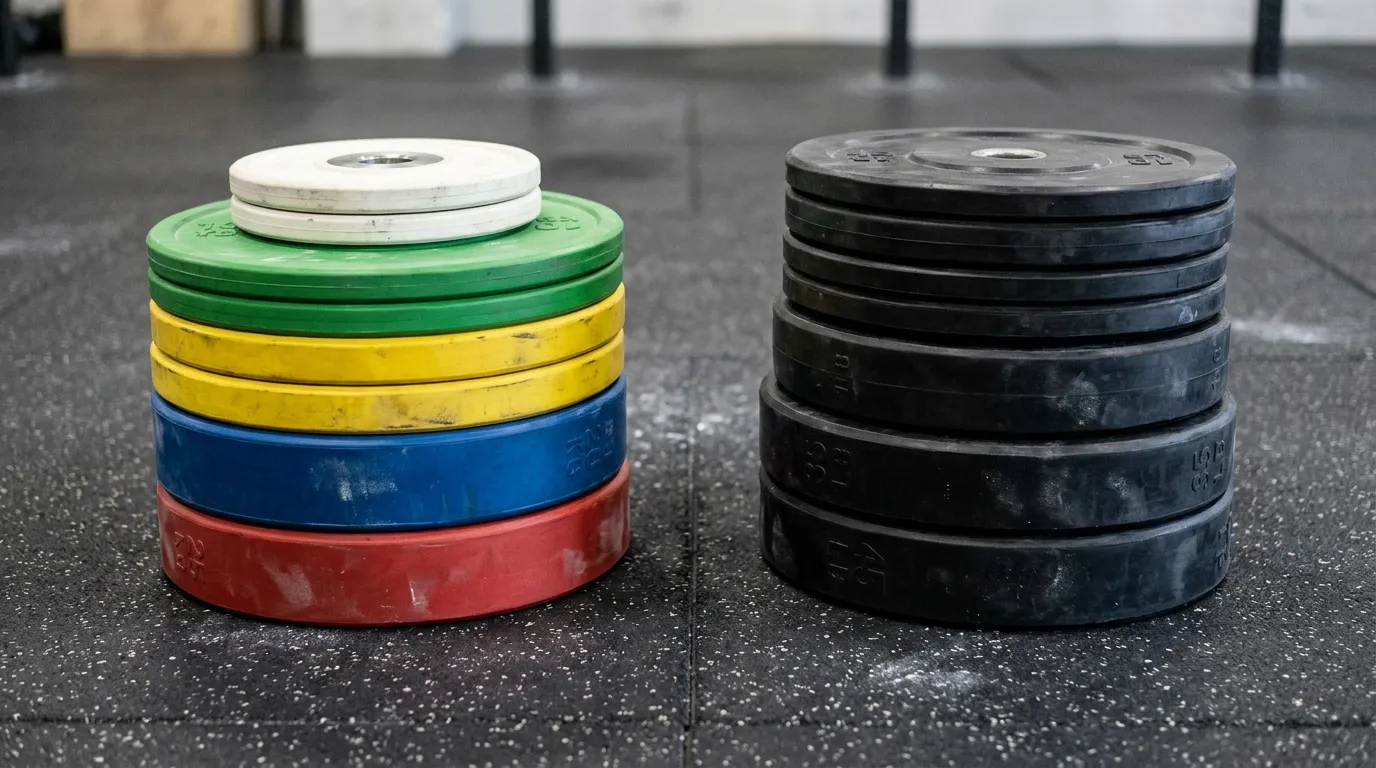
We’d put the heaviest plates closest to the middle, lighter ones outside. The tool draws it that way. The reason is dull but handy: when both sides are built the same, a mismatch stands out before you unrack.
Exact weights aren’t always on offer. Your smallest jump is twice your lightest plate. With a 2.5 kg plate as the smallest, the load moves in 5 kg steps. Add 1.25 kg plates and it’s 2.5 kg, and with 0.5 kg plates it’s 1 kg. When your target falls between steps, the plate loader calculator shows the closest load it can make and the next one the other way.
The count climbs slowly, then jumps. Past 240 kg you’re thinking about sleeve space, which the tool doesn’t check.
Most lifters hit a different wall first: the rack. If it holds only two pairs of 25s, that’s 120 kg on a 20 kg bar and no more. The plate loader calculator lets you set how many pairs you own, so it won’t hand you a stack you can’t build.
Do plates weigh what they say?
Not exactly. IWF equipment rules let a competition 20 kg disc weigh anywhere from 19.990 to 20.020 kg. Training discs get a wider window: 19.840 to 20.160 kg, which is 0.8% either way, or 160 g on one plate.
| Disc | Competition | Training |
|---|---|---|
| 25 kg | 24.9875 to 25.0250 | 24.800 to 25.200 |
| 20 kg | 19.9900 to 20.0200 | 19.840 to 20.160 |
| 15 kg | 14.9925 to 15.0150 | 14.880 to 15.120 |
| 10 kg | 9.9950 to 10.0100 | 9.920 to 10.080 |
| 5 kg | 5.0000 to 5.0100 | 4.960 to 5.040 |
| 2.5 kg | 2.5000 to 2.5100 | 2.480 to 2.520 |
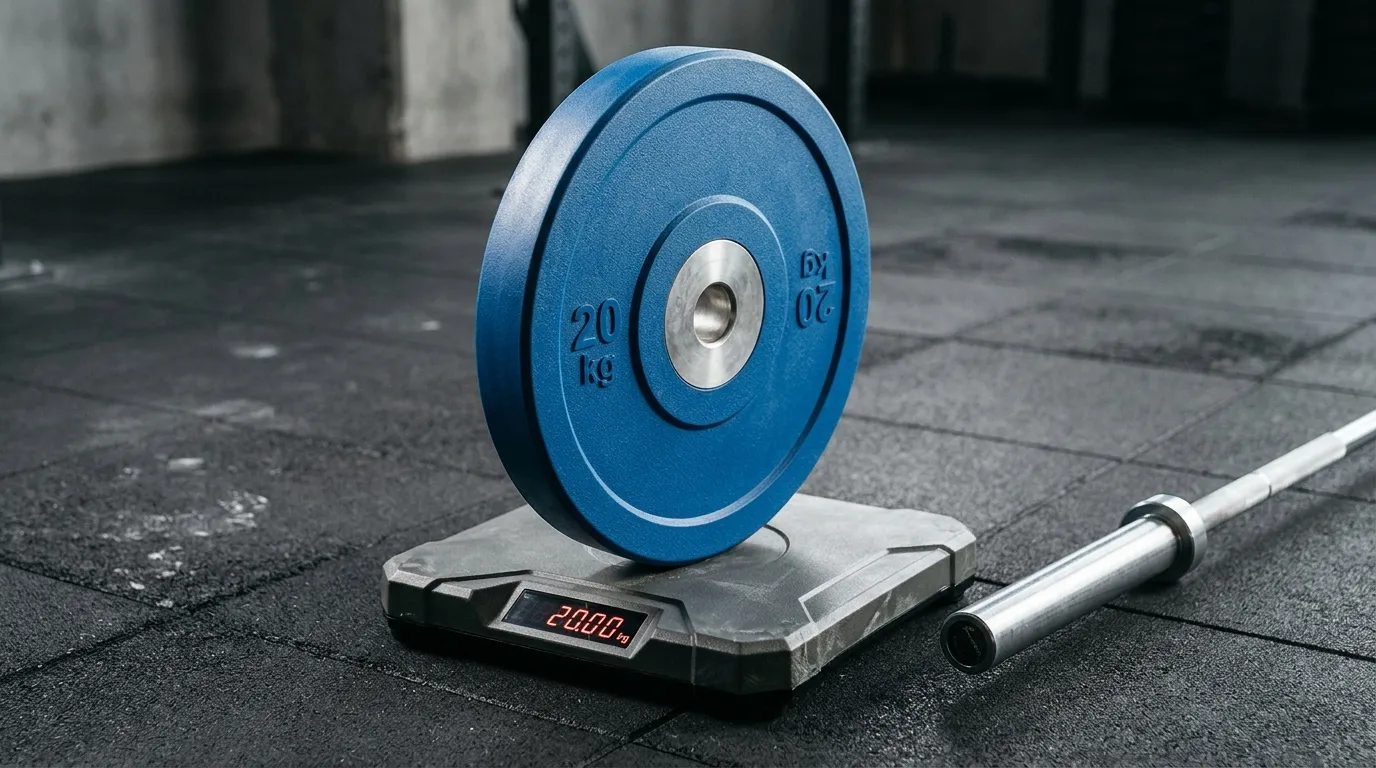
Those limits cover approved discs. Plates that aren’t certified can be off by more, so read the total from any plate loader calculator as the nominal load. Build 100 kg from two 25s and two 15s at the heavy end of the training window and the plates alone add 0.64 kg. For most lifting that doesn’t matter. If you’re chasing a number, say a one rep max attempt, log the plates you used and not only the total. Our one rep max calculator turns a hard set into an estimate, and the one rep max guide explains how far to trust it.
Which barbell plate calculator mistakes cost you the most?
These are the slips that make a plate loader calculator look wrong when it isn’t.
- Typing the plates-only weight when you meant the total with the bar.
- Following a kilogram program on pound plates without converting.
- Treating collars as zero when yours are 2.5 kg each.
- Assuming the bar is 20 kg because it looks like one.
- Building one side carefully, then eyeballing the other.
- Asking for a load your smallest plate can’t make.
- Forgetting that a 45 lb bar is 20.41 kg once you log in kilograms.
In our view the first is the easiest to fall into, since the number you type is the full bar weight.
Frequently asked questions
How do you work out plates per side?
Subtract the bar and any collars from your target, then halve what's left. For 100 kg on a 20 kg bar that's 40 kg a side, which is a 25 and a 15. The same sum works in pounds if you stay in one unit.
How much does an Olympic barbell weigh?
Under IWF rules a men's bar is 20 kg and a women's bar is 15 kg. Bars sold in pounds are usually 45 lb, about 20.4 kg. Check the label on yours.
Do collars count toward the weight?
Competition collars do. They're 2.5 kg each, so 5 kg a pair. Light spring clips are usually ignored, so pick no collars for those.
Which plates go on the bar first?
The heaviest, nearest the middle of the sleeve. That's how the tool draws it, and it makes a lopsided load easy to spot before you unrack.
What is 225 lb in kilograms?
About 102.1 kg. That's two 45 lb plates on each side of a 45 lb bar. A 100 kg load is 220.5 lb, so the two numbers aren't interchangeable, and mixing them quietly adds a couple of kilos.
Is the plate loader calculator free?
Yes. Our plate loader calculator is free, needs no account and runs in your browser, so nothing you type is stored.
What I’d actually do
Take a real session. Your estimated max is 140 kg and today’s squats call for 85%.
140 × 0.85 = 119 kg.
Take off the 20 kg bar and 99 kg of plates remain. That’s 49.5 a side. Your smallest plate is 2.5 kg, so the load moves in 5 kg steps and 119 isn’t on the menu.
The neighbours are 115 and 120. 120 is 2 × 25 each side. Four plates in all, done. 115 is 25 + 20 + 2.5 each side, six plates in all.
I’d take 120 on a good day, 115 on a flat one. That’s the whole routine: take the percentage, subtract the bar, halve it, snap to your plate steps. Either way I’d write down the plates and not just the total. Run your own numbers through the barbell plate calculator and check both sleeves match before you lift. More tools live in our strength tools.
If you’d rather have a whole month laid out for you, you can grab the $27 30-Day Reset program from our sister site Bodylix.