Fiber Calculator: How Much Fiber Per Day Do You Need?
A fiber calculator turns your daily calories, or your sex and age, into a fiber target in grams. For a 2,000 kcal day that target is 28 g, and for adults on the age table it runs from 21 g to 38 g.
The sum is easy. The harder parts are knowing which of two methods to trust, how much weight the research can carry, and how to climb toward a target without a week of bloating. This guide covers all of it, using numbers from our fiber calculator. You’ll see the rule worked out, the age table, a chart and a plan for closing the gap.
- The fiber calculator’s calorie route is calories ÷ 1,000 × 14. At 2,000 kcal that’s 28 g, and at 2,500 kcal it’s 35 g.
- The age route gives women 25 g and men 38 g up to age 50, then 21 g and 30 g after that.
- The routes can disagree. A woman aged 31 to 50 gets 25 g from the table but 28 g from 2,000 kcal.
- A 2019 Lancet review found the biggest benefit at 25 to 29 g a day. The average US adult eats 16.1 g.
- Mayo Clinic suggests adding about 3 g a week and holding each step for 7 to 10 days.
How much fiber per day does a fiber calculator give you?
One number, in grams, for a full day of eating. That sounds small, but it replaces a lot of guessing. Without a target you can’t say whether 20 g is fine or well short.
There are two routes. The first scales with appetite: eat more, and you’re asked to bring more fiber along. The second reads a fixed table by sex and age and ignores calories. The free fiber calculator runs both.
Then it draws your result against the average adult. Survey data from 2001 to 2010 put the mean US adult at 16.1 g a day, so against a 28 g target the gap is 11.9 g. Just over half the target.
Our view: read the result as a direction to move in, not a pass mark. Being 4 g closer than last month counts.
How does fiber per 1000 calories work?
The Institute of Medicine (IOM) set fiber at 14 g for every 1,000 calories. Multiply your daily calories by 14, then divide by 1,000. That’s all there is to fiber per 1000 calories.
At 2,000 kcal it’s 2,000 ÷ 1,000 × 14 = 28 g. At 2,500 it’s 35 g. The fiber calculator rounds to the nearest whole gram, because nobody weighs fiber to the decimal.
| Daily calories | Exact figure | Tool shows |
|---|---|---|
| 1,200 kcal | 16.8 g | 17 g |
| 1,600 kcal | 22.4 g | 22 g |
| 2,000 kcal | 28 g | 28 g |
| 2,400 kcal | 33.6 g | 34 g |
| 2,800 kcal | 39.2 g | 39 g |
| 3,200 kcal | 44.8 g | 45 g |
A bigger appetite means more food, and more food should bring more fiber with it. It isn’t a hard requirement, though. The IOM calls it an Adequate Intake, a best estimate used when evidence is too thin for a firm allowance, and it drew the number from heart disease studies.
The line only climbs: 21 g at 1,500 kcal, 42 g at 3,000. On the 14 g rule, 16.1 g is the target for a 1,150 kcal day. We’d call 14 g a sensible default and nothing sharper.
Not sure what you really eat? Our reverse TDEE calculator estimates maintenance calories from your food log and weight trend.
What does fiber intake by age look like?
The second route skips calories. The IOM also published a fixed table of daily amounts for each age and sex, and the sex and age route in our fiber calculator reads straight from it. Under age 9, boys and girls share one number: 19 g for ages 1 to 3 and 25 g for ages 4 to 8.
| Age | Girls and women | Boys and men |
|---|---|---|
| 9 to 13 | 26 g | 31 g |
| 14 to 18 | 26 g | 38 g |
| 19 to 30 | 25 g | 38 g |
| 31 to 50 | 25 g | 38 g |
| 51 to 70 | 21 g | 30 g |
| over 70 | 21 g | 30 g |
Fiber intake by age steps down after 50, and the two routes won’t always agree. A woman aged 31 to 50 gets 25 g from the table, while 2,000 kcal on the calorie route says 28 g. Run the 14 g rule backwards and each table figure lines up with a calorie level: 21 g with about 1,500 kcal, 25 g with about 1,790, 30 g with about 2,140 and 38 g with about 2,710. Eat well above or below those and the calorie route fits you better.
Our view: use the calorie route whenever you know your intake, and the table when you don’t. A wild guess at calories makes the sum worse than skipping it.
How much fiber do I need? Using the fiber calculator
Enter your calories, or your sex and age, and see your daily fiber target in grams beside the average adult intake. Free, no sign-up.
Open the calculator- Pick a method: from calories, or from sex and age.
- For calories, type what you eat in a day. For the table, choose female or male and enter your age in years.
- Press Show my fiber target.
- Read the grams, then look at the bar that sits next to the average adult.
- Check the working underneath if you want to see how the tool got there.

The fiber calculator wants a whole number of calories and an age of 1 or over, since there’s no figure for babies under 1. It has no switch for pregnancy or breastfeeding (see the mistakes list below). It lays out its working in a step-by-step table under the result.
We’d say run both routes once. If they land within a few grams of each other, you can stop worrying about which is right.
What do high fiber targets look like in the research?
The 25 to 29 g range comes from a 2019 Lancet review by Reynolds and colleagues. It pooled 185 prospective studies, covering nearly 135 million person-years, plus 58 clinical trials with 4,635 adults.
| Outcome | Studies | Relative risk (95% CI) | Evidence grade |
|---|---|---|---|
| Death from any cause | 10 | 0.85 (0.79 to 0.91) | Moderate |
| Coronary heart disease | 9 | 0.76 (0.69 to 0.83) | Moderate |
| Type 2 diabetes | 17 | 0.84 (0.78 to 0.90) | Moderate |
Read 0.85 as about 15% lower risk of death from any cause, and 0.76 as about 24% lower for coronary heart disease. The biggest benefit showed at 25 to 29 g a day: 6 of 7 key outcomes improved in that band, against 3 of 7 at 15 to 19 g and 4 of 7 at 20 to 24 g.
Most of this evidence is observational, so it shows an association and can’t prove cause. The review’s authors argue that trial results and dose-response curves point toward a causal link. Our take: strong enough to aim at, too loose to chase to the gram.
Sources disagree on how high to go. The review says at least 25 to 29 g, with more benefit past 30 g, and a Mayo Clinic Q&A says 30 to 40 g. With high fiber targets like those, reach 25 g first and see how your gut copes.
Can fiber for weight loss move the scale?
The same review pooled randomized trials, and one result bears on fiber for weight loss. Across 27 trials, higher fiber intakes went with body weight about 0.37 kg lower than lower intakes, within a range of 0.11 to 0.63 kg. Small.
Two caveats. Weight loss trials were left out, so this isn’t evidence from people dieting on purpose. And the trials ran at least four weeks, which says little about the long game.
One possible reason: the review suggests whole foods that need chewing are more likely to raise fullness. Reviews of fiber supplements have found only small effects on appetite.
Cutting calories moves the fiber calculator’s target too. At 1,600 kcal the calorie route gives 22 g, and at 1,200 kcal it gives 17 g. In our view, fiber for weight loss is a helper. Get it from foods, keep calories where your plan needs them, and don’t expect fiber to carry a cut by itself.
How much fiber per day can you add without the bloat?
Raising fiber too fast is the classic way to dislike it, and no fiber calculator can feel your gut for you. Mayo Clinic suggests adding about 3 g a week, holding each level for seven to 10 days, and drinking plenty of water, with a goal of 80 ounces a day (about 2.4 liters).
Take the average US adult at 16.1 g and a 28 g target. Four steps of 3 g get there.
| Step | Daily fiber | Reached on |
|---|---|---|
| Now | 16.1 g | Baseline |
| Step 1 | 19.1 g | Day 0 |
| Step 2 | 22.1 g | Day 7 to 10 |
| Step 3 | 25.1 g | Day 14 to 20 |
| Step 4 | 28 g (target) | Day 21 to 30 |
That’s three to four weeks from first step to finish. Step 4 would be 28.1 g, so it stops at the target.
For a sense of the extra grams, vegetables are the biggest single source for US adults, at 22.6% of fiber, ahead of grain mixtures at 12.0% and fruits at 11.1%.
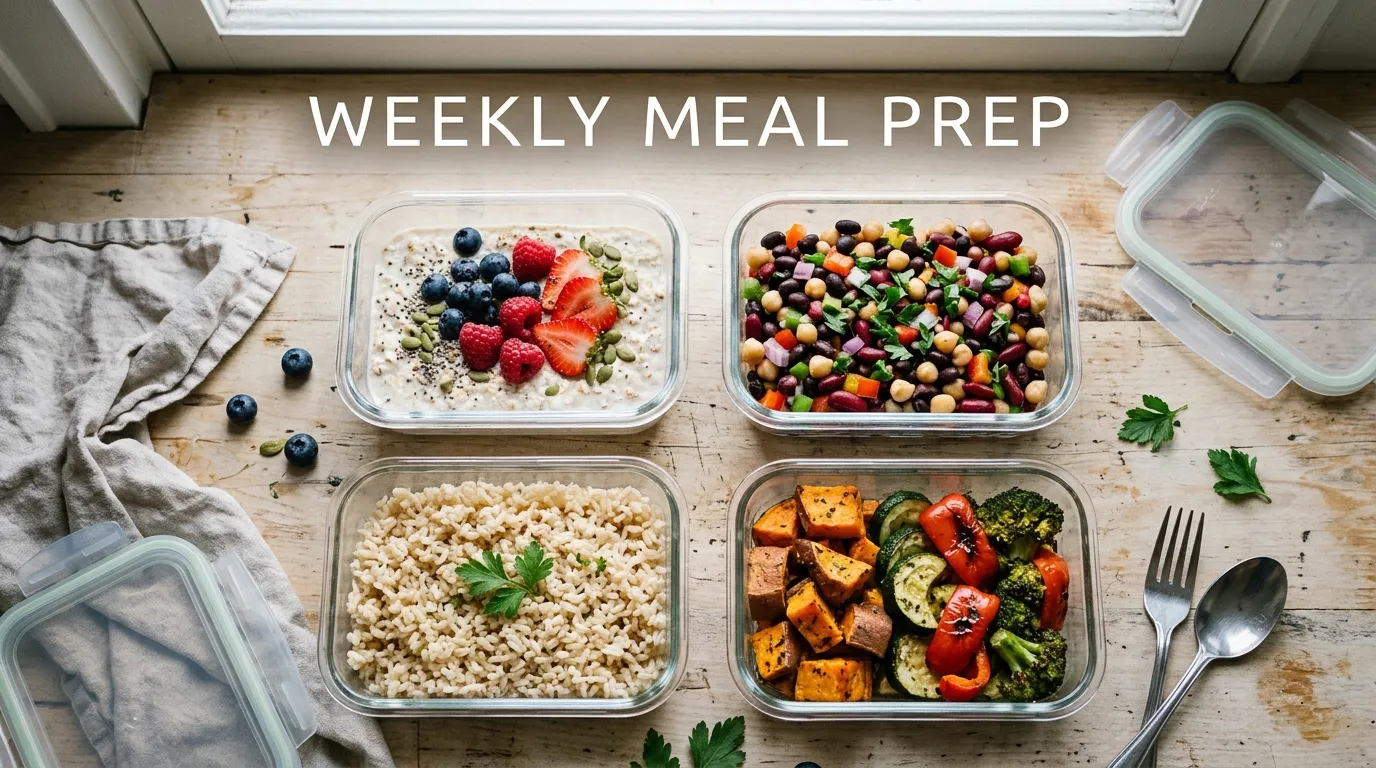
Mayo also says fiber is best from food, since whole foods carry a mix of fibers. Our pick: choose three foods you already like and add a serving of one each week. Boring works.
Which mistakes make high fiber targets backfire?
A few slips make a fiber calculator look wrong when it isn’t.
- Jumping from 16.1 g to 28 g in a week, then blaming the target when your gut complains.
- Typing the calories you plan to eat when you meant what you actually eat.
- Using the table result during pregnancy or breastfeeding, when the IOM sets 28 g and 29 g for ages 14 to 50.
- Counting powders and fortified bars the same as whole foods, when most of the research is about foods.
- Treating the target as a daily pass or fail.
- Forgetting water.
We’d say the first one does the most damage, because speed is the part you control.
Frequently asked questions
How much fiber do I need each day?
For most adults up to 50, the Institute of Medicine's table gives 25 g for women and 38 g for men. After 50 it drops to 21 g and 30 g. Scaling by calories is the other route.
Is 14 grams per 1,000 calories a hard rule?
No. It's an Adequate Intake, a best estimate rather than a requirement. The Institute of Medicine had too little evidence for a firm allowance, so it built the figure from heart disease data.
Which fiber calculator route should I use?
Use calories if you know your intake. If you don't, the age and sex table is the safer fallback. The two can differ by a few grams, and that's normal.
Does fiber help with weight loss?
A little, going by trial data. Across 27 trials, higher fiber intakes went with about 0.37 kg lower body weight. That's a small effect, so fiber alone won't carry a diet.
Can you eat too much fiber?
Probably not by accident. The IOM set no upper limit, and the Lancet review found no harm tied to fiber in its studies, though very high intakes might trouble people with borderline iron status. Adding too much too fast brings gas and bloating.
Is the fiber calculator free?
Yes. Our free fiber calculator needs no account and runs in your browser, so nothing you type is stored.
What I’d actually do
Say you type 2,000 kcal into the fiber calculator and sit near the national average of 16.1 g.
2,000 ÷ 1,000 × 14 = 28 g.
The gap is 11.9 g. Too much to close in a week.
So I’d go in steps of 3 g, holding each for a week or so. 19.1, 22.1, 25.1, then 28. About a month in all.
Across three meals that’s roughly 9.3 g each. Beans, whole grains, vegetables and whole fruit do most of the work.
If 28 feels steep, 25 g is the low end of the research range and a fine first stop. Then run your own numbers through the fiber calculator, check the age table as well, and see where the two land. If calories are the shaky part, our reverse TDEE guide covers that, and the protein calculator pairs well with this one. More tools live in our nutrition tools.
If you’d rather have a whole month laid out for you, you can grab the $27 30-Day Reset program from our sister site Bodylix.