One Rep Max Calculator: How to Estimate Your Bench, Squat and RPE Max

A one rep max calculator estimates the heaviest weight you could lift once, based on a lighter set you’ve already done. Enter the weight and the reps, and a formula like Epley’s fills in the rest. No heavy single, no nerves.
Sounds simple, and it is. The catch is that the answer only ever matches the quality of your set. Five crisp reps tell the formula plenty. Fifteen tired ones tell it next to nothing. So this guide covers the maths, how RPE patches the biggest blind spot, and where bench and squat behave differently. When you’re ready to plug numbers in, our one rep max calculator does the sums and builds your percentage table.
- Feed any 1RM calculator one hard set of 3 to 6 clean reps. Past roughly 10, it’s guessing.
- Epley: weight × (1 + reps ÷ 30). Brzycki: weight × 36 ÷ (37 − reps). Same answer at 10 reps, different below.
- The one rep max calculator RPE trick: add the reps you had left to the reps you did. Five at RPE 8 counts as seven.
- A one rep max calculator bench result and a one-rep max calculator squat result don’t share one perfect formula. Read each as a range.
- It’s a planning number. It isn’t a PR.
What does a one rep max calculator actually do?
It turns a submaximal set into an estimate of your single-rep strength. Your 1RM is the most you can move through one full rep with good technique, and finding it the hard way takes long warm-ups, a spotter and a bit of nerve. A calculator skips all that. You lift something heavy for a few reps and the formula works backward.
Boyd Epley’s version came out of a poundage chart in a Nebraska strength manual in 1985, and Matt Brzycki published his in a physical education journal in 1993. Coaches wrote both for clipboards, not lab benches. Which is why we’d ignore any decimal point a calculator throws at you.
Here’s our honest take: a 1RM calculator is a planning tool. If it says 140 kg and you’ve never touched 140, you’ve got a number to set percentages from. You don’t have a record.
How do you calculate a one rep max by hand?
Multiply the weight by (1 + reps ÷ 30). That’s Epley, and it’s the formula behind our tool.
- Warm up, then pick a load you can lift for roughly 3 to 6 hard reps.
- Take the set to failure, or very close, with the same form on every rep.
- Write down the weight and reps: say, 80 kg for 6.
- Divide the reps by 30. Six ÷ 30 = 0.2.
- Add 1 to get 1.2.
- Multiply by the weight: 80 × 1.2 = 96 kg.
Push that same set through Brzycki and you get 80 × 36 ÷ 31 = 92.9 kg. Three kilos apart on identical data. If mental arithmetic isn’t your thing, the 1RM calculator on our site runs both the sum and the percentage table in one click.
How do you use our 1RM calculator?
Enter your weight and reps, pick kg or lb, and get your estimated 1RM plus a full training-percentage table. Free, no sign-up.
Open the calculator- Do one hard set of 3 to 6 clean reps, at or near failure.
- Enter the weight, the reps and your unit. Tracked an RPE? Add your reps in reserve to the reps first (more on that below).
- Read the estimate, then the percentage table under it.
- Save the number with the date. Retest in four to six weeks.
Which 1RM formula is most accurate?
None of them wins everywhere. Epley and Brzycki return the same answer at ten reps and part ways below that, with Epley reading higher. Here’s what four common equations say about one 100 kg set:
| Set | Epley | Brzycki | Lombardi | O’Conner |
|---|---|---|---|---|
| 3 reps | 110.0 kg | 105.9 kg | 111.6 kg | 107.5 kg |
| 5 reps | 116.7 kg | 112.5 kg | 117.5 kg | 112.5 kg |
| 8 reps | 126.7 kg | 124.1 kg | 123.1 kg | 120.0 kg |
| 10 reps | 133.3 kg | 133.3 kg | 125.9 kg | 125.0 kg |
The spread widens as reps climb, from about 5 kg at five reps to about 8 kg at ten. In a 1997 study, researchers tested seven equations on 67 untrained college students across bench, squat and deadlift. Every equation correlated strongly with the real max (r above 0.95). Even so, the average miss was significantly off zero for most equations on bench and squat, and all seven undershot the deadlift.
We’d use Epley for sets of 3 to 8 reps, because you can check it on a napkin. Keep Brzycki as a second opinion. If the two disagree by more than a few kilos, your set was probably too long.
Why do estimates get worse as reps go up?
Fatigue takes over from strength. A heavy five mostly measures top-end strength. A set of fifteen measures endurance, pacing and how long you’ll put up with the burn.
The research agrees. Reynolds and colleagues tested 70 adults on bench press and leg press. The 5RM gave the best predictions, and they advised no more than ten reps for linear equations. A separate study of 34 young men found a 4 to 6RM predicted a max better than a 7 to 10RM.
| Reps in your set | How far to trust the estimate |
|---|---|
| 3 to 6 | Your best bet. The 5RM predicted best in the 70-adult study. |
| 7 to 10 | Usable, a bit looser. Still inside the ten-rep ceiling researchers suggested. |
| 11 or more | Outside the advised range. Do a heavier set instead. |
One rep max calculator RPE: how does effort change the number?
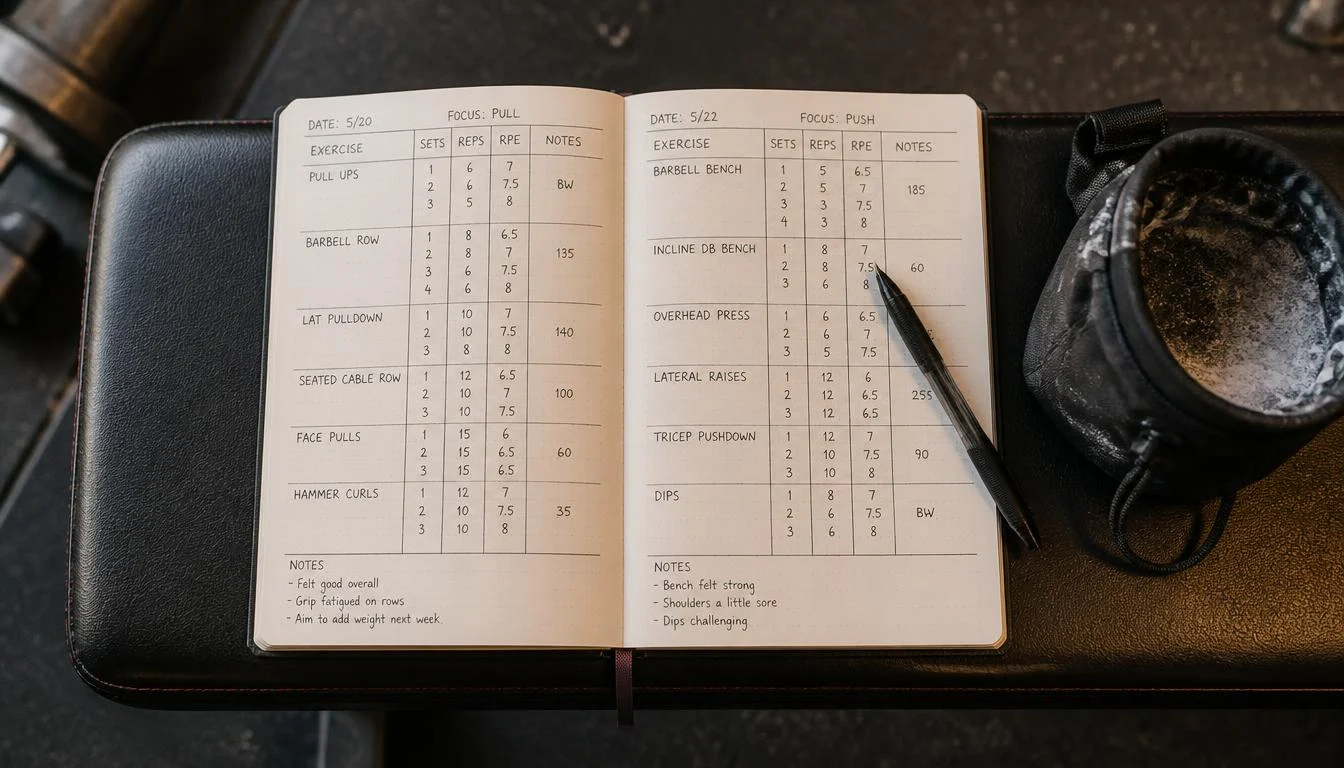
RPE tells the formula how many reps you had left, and those reps count too. On the reps-in-reserve scale, RPE 10 means nothing left, RPE 9 means one rep left, RPE 8 means two, and so on.
That’s the whole one rep max calculator RPE trick. Subtract your RPE from 10, add the answer to the reps you did, and enter the total as your reps. Say you lift 100 kg for 5 at RPE 8. Two in reserve means you type 7. Our tool shows 123.5 kg (the raw sum is 123.3, and it rounds to the nearest half kilo). Type 5 instead and you get 116.5 kg. That’s a gap of about 6%, from one honest rating. Keep the total at 12 or under.
Now the catch. The scale comes from work by Zourdos and colleagues, who tested 29 squatters, 15 of them experienced and 14 novices. Helms and colleagues later noted that experienced lifters judge RPE more accurately than beginners. A newer lifter’s “RPE 8” may hide more reps than it feels like.
If that’s you, round your rating up. A harder RPE adds fewer imaginary reps, so the estimate lands on the cautious side. Underestimating your max for a few weeks costs nothing. Overestimating it can cost you a missed lift.
One rep max calculator for bench: what should you expect?
If you’ve searched for a one rep max calculator bench version, here’s the good news: there isn’t a special one. The maths is the same for every barbell lift. What changes is how well it fits. In that 1997 study, the average gap between predicted and achieved bench presses differed significantly from zero for all but two of the seven equations.
So use a set of 3 to 6 reps with a spotter or safeties, then run it through the one rep max calculator and expect a result near your real max, not on it. Picture this: five at 80 kg with a pause on Monday, five at 82.5 with a bounce on Friday. Same lifter, different data. Pick one style and stick to it.

A one rep max calculator bench estimate is only as honest as your slowest, cleanest rep. We’d skip true-failure sets unless someone’s watching, since an RPE 9 set tells you nearly as much with a lot less drama.
One-rep max calculator squat results: why do they feel different?
Punch a squat set into any one-rep max calculator squat tool and the answer can feel off. Reps and percentage don’t line up the same way on every lift. In a 2006 study, eight trained and eight untrained men did back squats, bench presses and arm curls to failure at 60%, 80% and 90% of their 1RM. Squats allowed more reps than the other lifts at 60%, and the gaps narrowed at heavier loads.
The 1997 study points the same way: the squat’s average prediction error was significantly off zero for all but one equation. Translation: treat any one-rep max calculator squat estimate as a range, not a single number.
Set your depth standard and safety bars before you start, then program from the lower end of the range. Honestly, it’s the smarter play on any lift where a missed rep pins you. Then run the set through our 1RM calculator.
How do you use your estimated 1RM in training?
Multiply the estimate by the percentage your program calls for, then round to the plates you own. Suppose the calculator says 120 kg:
| % of 1RM | Load | Reps to failure |
|---|---|---|
| 90% | 108 kg | about 3 reps |
| 85% | 102 kg | about 5 reps |
| 80% | 96 kg | about 8 reps |
| 75% | 90 kg | about 10 reps |
| 70% | 84 kg | about 13 reps |
Those rep counts come straight from the Epley formula, so real life will vary. In the 2006 study above, training status barely changed how many reps men managed at a given percentage, but the exercise did. The percentage table in our one rep max calculator does this maths for every load from 50% to 100%. And if your estimate is months old, do a fresh set of five first.
What mistakes skew a 1RM estimate?
- Feeding a 1RM calculator a set of 15 and hoping for the best.
- Counting ugly reps. If your form broke on rep four, it was a set of three.
- Comparing a fresh Monday number with a wrecked Friday one.
- Switching bench styles or squat depth between tests.
- Rounding your RPE down to look tough.
- Logging an estimate as a PR. It’s a prediction until a bar actually moves.
Frequently asked questions
How accurate is a one rep max calculator?
Close enough to plan training, not close enough to log as a record. In a 1997 study of 67 untrained students, estimates correlated strongly with real maxes, yet average gaps were still significant for most equations. Expect a few percent of wiggle room, more if your set was long or sloppy.
Can I use a 1RM calculator with a set of 15 reps?
You can type it in, but the answer is mostly guesswork. Research on linear prediction equations suggests keeping the input set to ten reps or fewer. Fatigue starts to decide the outcome past that point. Do a heavier set of three to six reps instead and the estimate tightens up.
How does a one rep max calculator RPE adjustment work?
Subtract your RPE from 10 to get reps in reserve, then add those reps to the ones you completed. Five reps at RPE 8 leaves two in the tank, so the formula sees seven. Be honest with the rating. If you're unsure, pick the harder RPE so the estimate errs low.
Is a one rep max calculator for bench different from squat?
The math is identical, but the reality isn't. A 2006 study found the reps you can do at a given percentage differ between squat and bench, so one formula fits each lift a little differently. Use the same technique every test and treat squat and bench results as ranges.
How often should I recalculate my one rep max?
Every four to six weeks is generally recommended by trainers, and it's a sensible default. Testing more often mostly measures how you slept. If your program runs on percentages, recalculate whenever a training block ends or a working set feels much easier than planned.
Do I need a spotter for the set I use?
Yes for bench, and safety arms or a rack for squat. Using a calculator is meant to avoid heavy singles, but a hard set of five still ends near failure. Stopping one rep short with good form gives a nearly identical estimate and removes most of the risk.
What I’d actually do
Pick one lift this week. Warm up, do a single clean set of five at RPE 8 or 9, and note how many reps you had left. Add those to your reps and run the total through the one rep max calculator, using the one rep max calculator RPE method from earlier. Write the number down with the date. Repeat in four to six weeks. If the estimate climbs, your program is working. If it doesn’t, check sleep and food before you blame the formula.
Small experiment: work out Epley and Brzycki for the same set and note the gap. That gap is your honest margin of error, and it’s more useful than either number alone. When you’re comfortable, browse the rest of our strength tools.