Lean Body Mass Calculator: How to Work Out Your Lean Mass
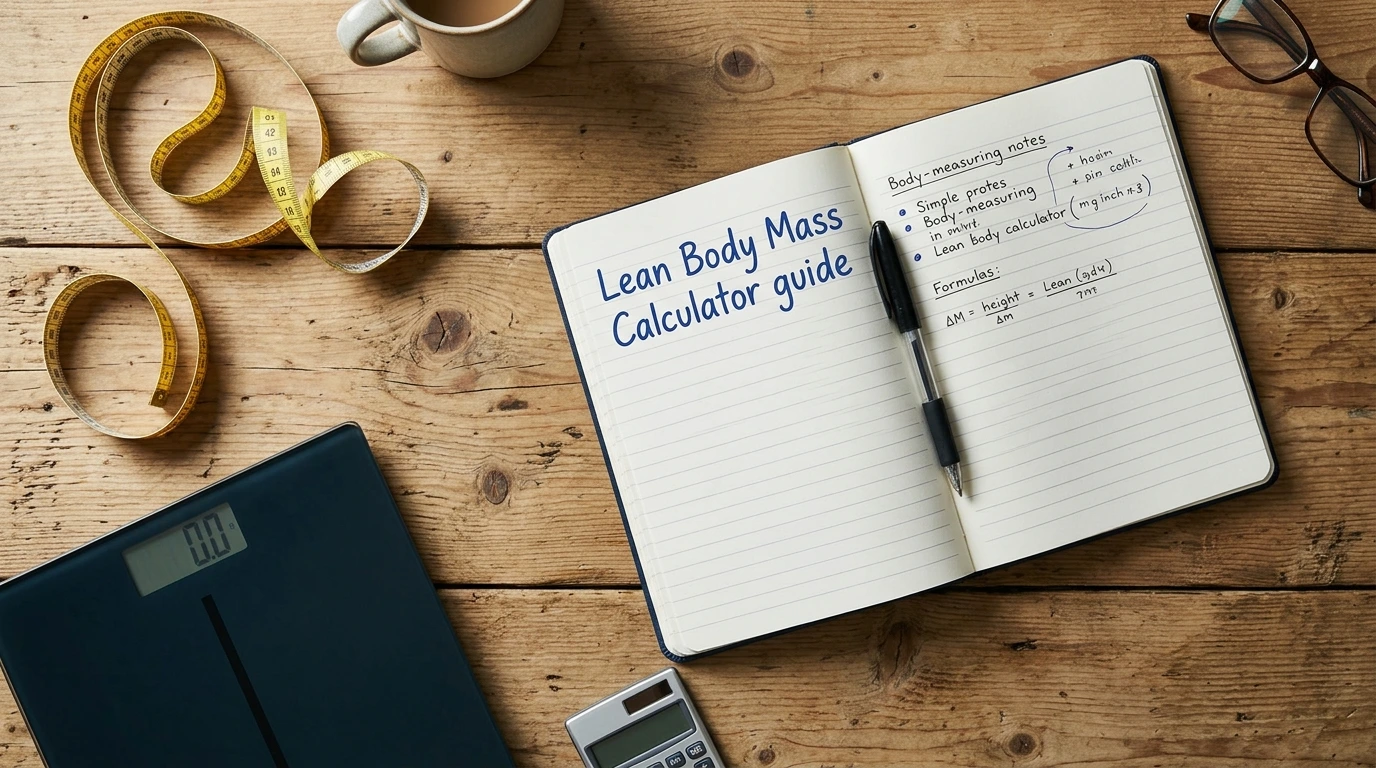
A lean body mass calculator tells you how much of your weight is everything except fat: muscle, bone, organs, blood and the water in all of them. Give it your height, weight and sex, or a body fat percentage, and you get a figure in kilograms or pounds.
This guide walks through the sums behind our lean body mass calculator: the three equations it runs, the body fat shortcut, and why the answers never quite match. You’ll see four builds worked out, find out where the James equation goes wrong, and leave with a simple rule for picking a method.
- With a body fat reading, lean mass = weight × (1 − body fat ÷ 100). At 80 kg and 18%, that’s 65.6 kg lean and 14.4 kg fat.
- For a man at 80 kg and 178 cm, Boer gives 60.9 kg, James 62.1 kg and Hume 57.1 kg. That’s a 5.0 kg spread.
- Give that same man 18% body fat and the answer is 65.6 kg, which is 8.5 kg above Hume.
- James peaks at a BMI of about 43 for men and 36 for women. Past that, more weight lowers the estimate.
- Hume against DXA in 100 people: a correlation of 0.913, but limits of agreement from −8.26 to +6.52 kg.
What does a lean body mass calculator do?
It splits your weight into two piles. Fat is one. Everything else is the other, and that second pile is your lean body mass. A lean body mass calculator gets there by one of two routes, and the route depends on what you already know about yourself.
If you’ve got a body fat percentage, it’s subtraction. Don’t have one? Then three published equations estimate lean mass from height, weight and sex. The free lean body mass calculator on this site runs all three at once, so you can see how far apart they land before you trust any single figure.
Lean mass is bigger than muscle mass, and people mix the two up all the time. A lean figure of 65 kg doesn’t mean 65 kg of muscle. Bone, organs and water sit inside it too. Our view: decide what you want the number for before you pick a method. Tracking your own trend over a few months asks little of a calculator. Comparing yourself with a stranger’s figure asks a lot.
What is the lean body mass formula?
There’s no single lean body mass formula. There are several, and they disagree. The three in our tool come from Boer (1984), James (1976) and Hume (1966). W is your weight in kilograms and H is your height in centimeters.
| Equation | Men | Women |
|---|---|---|
| Boer (1984) | 0.407 × W + 0.267 × H − 19.2 | 0.252 × W + 0.473 × H − 48.3 |
| James (1976) | 1.10 × W − 128 × (W ÷ H)² | 1.07 × W − 148 × (W ÷ H)² |
| Hume (1966) | 0.32810 × W + 0.33929 × H − 29.5336 | 0.29569 × W + 0.41813 × H − 43.2933 |
The Boer formula and the Hume formula are straight lines: a bit more for every kilo, a bit more for every centimeter, minus a constant. The James formula squares the weight-to-height ratio, which bends the curve. That bend causes trouble later on.
Try a man at 80 kg and 178 cm. Boer returns 60.9 kg, James 62.1 kg and Hume 57.1 kg. A 5.0 kg spread, and nobody has made a mistake yet. Put your own height and weight into the lean body mass calculator and the three answers appear together.
How to calculate lean mass from body fat percentage
This route needs no equation worth the name. Take your weight, remove the fat, keep the rest.
At 80 kg and 18% body fat that’s 80 × 0.82 = 65.6 kg lean, which leaves 14.4 kg of fat. Done.
| Body fat | Lean mass | Fat mass |
|---|---|---|
| 10% | 72.0 kg | 8.0 kg |
| 15% | 68.0 kg | 12.0 kg |
| 18% | 65.6 kg | 14.4 kg |
| 20% | 64.0 kg | 16.0 kg |
| 25% | 60.0 kg | 20.0 kg |
| 30% | 56.0 kg | 24.0 kg |

A few points of body fat move the answer a lot. Going from 15% to 25% costs the same 80 kg person 8.0 kg of lean mass on paper. It also means the sum is only as good as the reading feeding it. If you don’t have one, our body fat percentage calculator gives an estimate from tape measurements.
Our view: if you have a body fat reading you’d trust even a little, use this route. It sees something about you that height and weight can’t. The tool’s From body fat % mode runs the sum and draws the result against your weight.
How to use our lean body mass calculator
Our lean body mass calculator has two modes, and the steps shift slightly between them.
Enter height and weight, or a body fat percentage, and see your lean mass drawn against your body weight. Three formulas side by side. Free, no sign-up.
Open the calculator- Choose Height and weight, or From body fat %.
- Switch between kg and cm, or lb and inches.
- For the height-and-weight mode, pick male or female.
- Type your body weight, then your height or your body fat.
- Pick which formula drives the main number: Boer, James or Hume.
- Press Show my lean mass. The whole bar is your body weight and the filled part is lean.

The lean body mass calculator has two safeguards built in. At very low BMI an equation can return more lean mass than you weigh, so the tool caps the result at your body weight and tells you. And when your BMI passes the James turning point, you get a flag.
Our view: pick one formula for the main number and leave it there. Switching halfway through a trend is the easiest way to fool yourself.
Boer formula vs James and Hume: which should you pick?
Run four builds through every equation and the same people get three different answers. Any lean body mass calculator that shows only one of them hides this spread.
| Build | Boer | James | Hume | Gap |
|---|---|---|---|---|
| Man, 80 kg, 178 cm | 60.9 kg | 62.1 kg | 57.1 kg | 5.0 kg |
| Man, 95 kg, 185 cm | 68.9 kg | 70.7 kg | 64.4 kg | 6.3 kg |
| Woman, 62 kg, 165 cm | 45.4 kg | 45.4 kg | 44.0 kg | 1.4 kg |
| Woman, 75 kg, 170 cm | 51.0 kg | 51.4 kg | 50.0 kg | 1.5 kg |
The gaps are wider for the men here, 5.0 and 6.3 kg against 1.4 and 1.5 kg for the women. Four builds is a small sample, though, so don’t read a rule into it.
The Boer formula comes from a 1984 paper in the American Journal of Physiology titled “Estimated lean body mass as an index for normalization of body fluid volumes in humans.” Read that title twice. The equations were built to scale fluid measurements to body size, not to grade anyone’s physique.
Hume’s 1966 paper in the Journal of Clinical Pathology used 29 men and 27 women. Lean mass came from total body water, measured with antipyrine, and the equations fit with multiple correlations of 0.96 for the men and 0.83 for the women. Fifty-six people, six decades ago, and the Hume formula is still in use.
In 2015 Carnevale and colleagues checked Hume against DXA in 100 people, 40 men and 60 women. The correlation for lean mass was 0.913. The limits of agreement still ran from −8.26 to +6.52 kg, a window 14.78 kg wide, and the equation read 1.36 kg high on average. Good correlation, wide net. For one person the error could be several kilos either way.
We couldn’t find a head-to-head test of all three on a sample we could open, so we won’t crown a winner. Our view: pick a formula, write down which one, and stay with it. Then a change over time is a change in you, not in the math.
Lean body mass vs fat free mass: are they the same?
Sometimes. Some sources use the two terms for one thing. Others keep a little essential fat inside lean body mass, so the numbers differ.
Our lean body mass calculator uses weight minus fat mass. Compare your result only with figures built the same way. Whenever you see lean body mass vs fat free mass in a table, check which definition the author used before you set it beside a DXA printout or a smart scale reading.
There’s a bigger gap to keep in mind: DXA scans and water-dilution methods measure. The equations predict. Take two men at 80 kg and 178 cm. All three formulas give them identical answers whether they carry 12% body fat or 28%. By the body fat route they hold 70.4 kg and 57.6 kg of lean mass, 12.8 kg apart, and height and weight can’t show it. Flip between modes in the lean body mass calculator and you’ll see the height-and-weight answer stay put when your body fat changes.
We haven’t tested the tool for teenagers, pregnancy or medical conditions, so treat results there with extra caution.
Why does the James formula drop at high weights?
The squared term. For men the James formula subtracts 128 × (W ÷ H)², for women 148 × (W ÷ H)², and that penalty grows faster than the 1.10 or 1.07 you earn per kilo. Set the slope to zero and the peak appears at a BMI of 42.97 for men and 36.15 for women. Beyond it, each extra kilo lowers the estimate.
The calculator flags it when your BMI passes the turning point. Try a heavy build in the lean mass calculator to see it. Our view: ignore James there and use Boer or Hume, which don’t bend.
Which lean body mass calculator mistakes cost you the most?
A handful of habits make a lean body mass calculator look wrong when it isn’t.
- Comparing a Boer number from one week with a Hume number from the next.
- Expecting a height-and-weight result to react to muscle you’ve gained. It can’t see muscle.
- Trusting the James formula above a BMI of 43 for men or 36 for women.
- Typing pounds while the kg setting is on.
- Feeding the body fat route a reading you wouldn’t bet a coffee on.
- Checking daily. Lean mass moves slowly, so compare readings weeks apart, taken the same way.
- Setting your figure beside a source that defines fat free mass differently.
In our view the second one catches the most people, because the result looks so precise.
Frequently asked questions
What is lean body mass?
Everything in you that isn't fat: muscle, bone, organs, blood and water. It's body weight minus fat mass, so someone at 80 kg carrying 14.4 kg of fat has 65.6 kg of lean mass.
How to calculate lean mass from body fat?
Multiply your weight by one minus your body fat as a decimal. At 80 kg and 18% that's 80 × 0.82, or 65.6 kg.
Which is better, the Boer formula, James or Hume?
Nobody has shown one beating the others in the evidence we could open. On our four builds they land 1.4 to 6.3 kg apart, so choose one and keep using it, or read the whole range.
Is lean body mass the same as muscle mass?
No. Lean mass holds muscle plus bone, organs and water, so it's always bigger than muscle alone, and the figure can't tell you how much of it is skeletal muscle.
Why does the James formula give lower lean mass at high weights?
Its squared term outgrows the weight term. For men that happens at a BMI near 43, for women near 36, and the calculator flags it.
Is the lean body mass calculator free?
Yes. There's no account to make, and the sums run in your browser, so nothing you type is stored or sent anywhere.
What I’d actually do
Take a man at 85 kg and 180 cm with a tape-measure body fat estimate of 16%.
The body fat route: 85 × 0.84 = 71.4 kg lean, 13.6 kg fat.
The formulas: Boer 63.5 kg, James 65.0 kg, Hume 59.4 kg.
That puts the formulas 6.4 to 12.0 kg under the body fat answer. They’d also disagree with each other by 5.6 kg.
I’d start from the body fat figure, since it’s the only route that saw anything about him. But a tape-measure estimate is a guess too, so I’d keep the whole range in mind and not quote one number.
Then I’d pick Boer for the formula side, write that down, and measure the same way each time. Say the scale reads 87 kg twelve weeks later and the tape still says 16%. The body fat route gives 73.1 kg, up 1.7. Boer gives 64.3 kg, up 0.8. Same man, two stories. The formula can only follow the scale.
So log the method, the date and the reading, not just the answer. Run your own figures through the lean mass calculator, then take the result to our protein calculator for a daily range. More tools sit under body composition, including the FFMI calculator.
If you’d rather have a whole month laid out for you, you can grab the $27 30-Day Reset program from our sister site Bodylix.